What Is Tartan?

This guide explains what tartan really is, where it came from, what the colors mean (and what they don’t), and how to pick one that’s yours. It also clears up a few myths that even a lot of Scots believe.
Table of contents
What Is Tartan, Exactly?
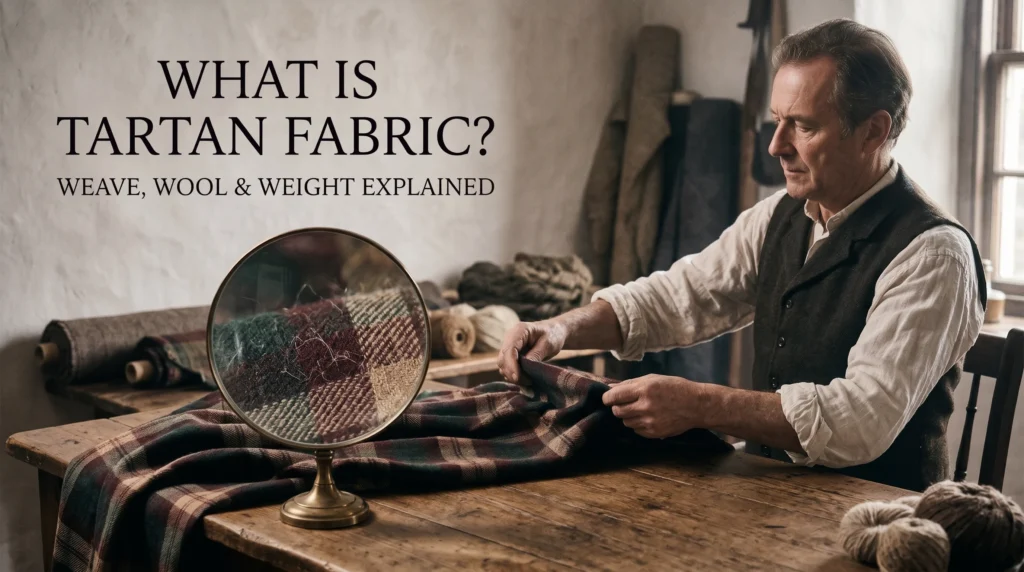
Tartan is a pattern, but it’s also a way of weaving. Every tartan starts with a sett. That’s the fixed order of colored stripes and how wide each one is. Think of it like a recipe: “six green, two black, one red, two black, and repeat.”
The weaver follows that recipe along the length of the cloth (the warp). Then they follow the exact same recipe across it (the weft). Where two stripes of the same color cross, you get a solid block. Where two different colors cross, they blend into a third shade. That’s why a tartan looks like it has more colors than it really does.
Most tartan is woven in a twill. Each thread goes over two and under two, which makes faint diagonal lines you can see if you look close at good wool. Twill is strong and hangs well, and that’s a big reason it works so nicely for a kilt.
One practical thing to know: not every checked fabric is tartan. A lot of cheap “tartan-look” cloth is just a pattern printed on plain fabric. Turn it over. Woven tartan shows the pattern on both sides. Printed cloth usually looks pale and washed out on the back.
Tartan vs Plaid
In the United States and Canada, “plaid” means any crisscross pattern, like a flannel shirt. In Scotland, it doesn’t. A plaid (from the Gaelic word for blanket) is a long piece of cloth that you wear over your shoulder. It can be made of tartan, but it isn’t the pattern itself.
So the easy way to remember it: tartan is the pattern, and in Scotland a plaid is the garment. If you’re in the US, people will understand either word. If you’re talking to a Scot, “tartan” is the safe choice. And gingham, the picnic-table check, is something else again. It’s just one color woven with white.
Where Tartan Came From
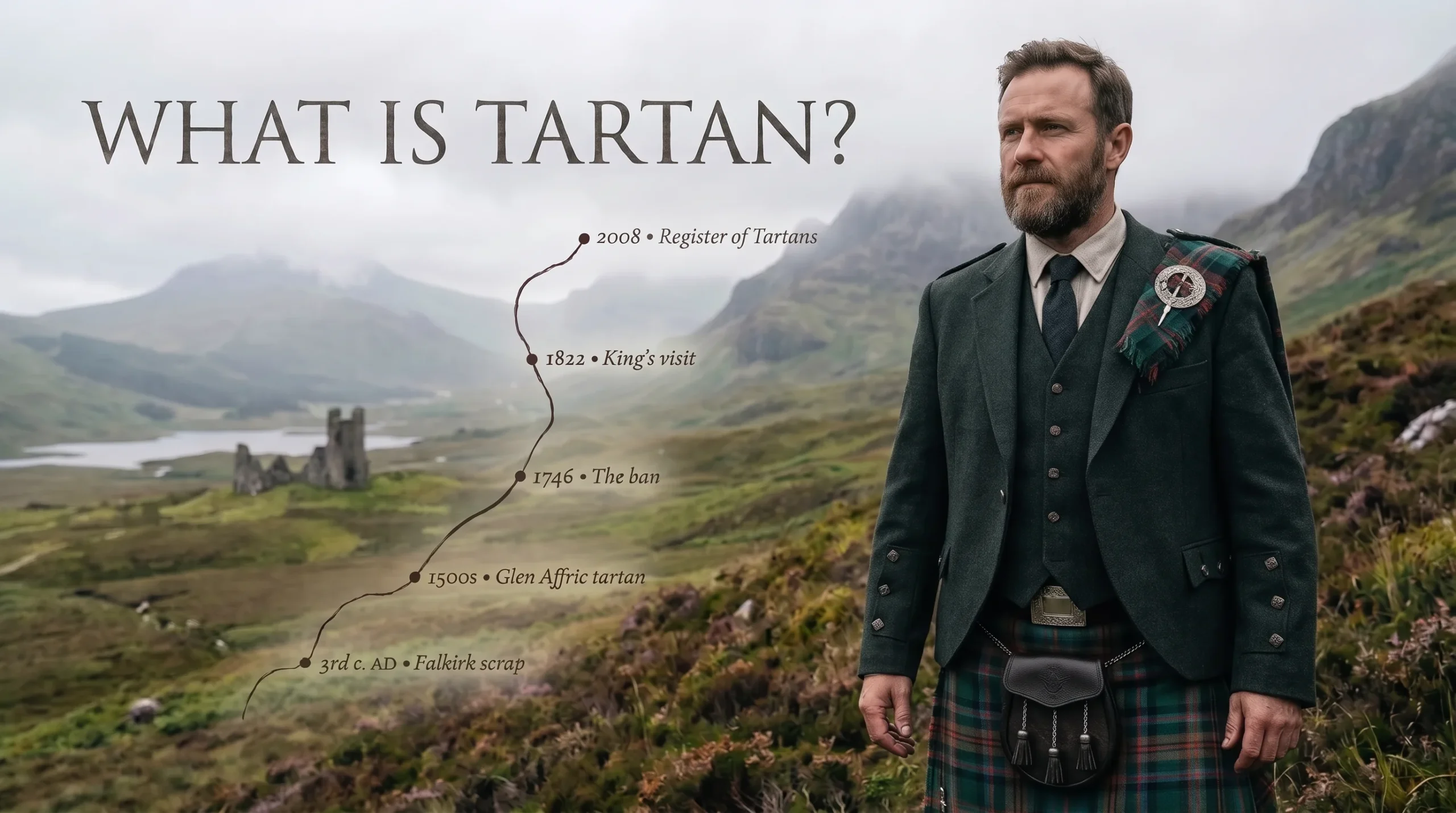
Nobody knows exactly when people first wove tartan. The oldest piece of true tartan we have was pulled from a peat bog in Glen Affric in the Highlands, about 19 miles west of Loch Ness. It was found in the 1980s. Radiocarbon testing has since dated it to somewhere between 1500 and 1600. It’s badly faded now, but it once had green, brown, red and yellow in it, made with natural dyes. There’s an older scrap called the Falkirk tartan, from around the 3rd century AD. But that one is a simple two-color check, so most experts don’t count it as true tartan.
For hundreds of years, Highlanders dyed wool with the plants, bark and berries growing nearby. Because of that, historians think early tartans were tied more to where a weaver lived than to a family name. The same valley tended to use the same colors.
The story changes in the 1700s. After the Jacobite Rising of 1745, the government banned most Highland dress, tartan included, with the Dress Act of 1746. Soldiers in Highland army groups were still allowed to wear it, and the dark blue-and-green Black Watch tartan comes from that army world. The ban ended in 1782, and tartan came roaring back.
Then, in 1822, King George IV visited Edinburgh. Writer Sir Walter Scott helped plan the visit, and clan chiefs were asked to turn up in their own tartans. That’s where the idea that every clan has its own tartan really took off. Some “ancient” clan tartans were even invented in the 1800s. Queen Victoria and Prince Albert made Highland style fashionable at Balmoral, and tartan went worldwide.
Here’s what that means for you. Tartan is both very old and partly a Victorian creation. That doesn’t make it fake. It just means tartan has always been alive and changing, and it still is.
What Does a Tartan Mean?
A tartan stands for whoever it was made for. That could be a family, a place, a regiment, a school, a company, or one single event.
Here’s the part many guides skip: the colors don’t have fixed meanings. You’ll hear that red is for blood and green is for the land. It’s a nice story, but there’s no rule. Colors were picked because of the dyes people had and what the designer liked. What carries the meaning is the tartan’s name and who it was made for. Here are the main kinds:
- Clan or familyStands for A surname and its family groupExample Campbell, MacDonald
- DistrictStands for A place in ScotlandExample Isle of Skye
- MilitaryStands for A regiment or army groupExample Black Watch
- RoyalStands for The royal familyExample Royal Stewart
- Everything elseStands for Schools, companies, cities, eventsExample 131 Argyle (a school in Hong Kong)
New tartans keep arriving. The official list is the Scottish Register of Tartans, created by the Scottish Parliament in 2008 and run by National Records of Scotland. It now holds more than 10,000 designs. Number 10,000 was a tartan called 131 Argyle, registered by a school in Hong Kong. So tartan isn’t only for old clans anymore. Anyone can design one and register it.
Modern, Ancient, Weathered: What the Color Names Mean
You’ll often see the same tartan sold in a few color versions. The names are confusing, so here they are in plain words:
- Modern. Deep, strong, dark colors. This is what most people picture.
- Ancient. Lighter, softer shades that imitate how old cloth looks after years of fading.
- Weathered. Earthy browns and greens, like cloth that’s lived outdoors.
- Muted. Somewhere in between: softer than modern, not as pale as ancient.
Don’t let the names fool you. “Modern” is not newer than “ancient.” It’s the same pattern in a different shade, with the same name. Pick the one you like. You may also see “dress” and “hunting” versions. Dress tartans usually include white and look brighter. Hunting tartans lean toward dark greens, blues and browns.
How to Find Your Tartan
Start with your surname. Many surnames link to a clan or a smaller family group. Not all do, though, and that’s fine. Here are some other ways in:
- Look at a grandparent’s name or the place your family came from. A district tartan can be a great fit.
- Pick a tartan you simply like. There is no tartan police.
- Choose a tartan that isn’t tied to one family. Plenty of people pick Black Watch because it looks sharp and works for anyone.
If you want a head start, you can look up tartans by surname and see which ones we carry. One tip from experience: tartan can look different on a screen than in real life, so check the shade carefully before you commit to a big purchase. For a wedding, it’s also worth asking what the rest of the party is wearing. Matching the same tartan across the group is common.
Where You’ll See Tartan Today
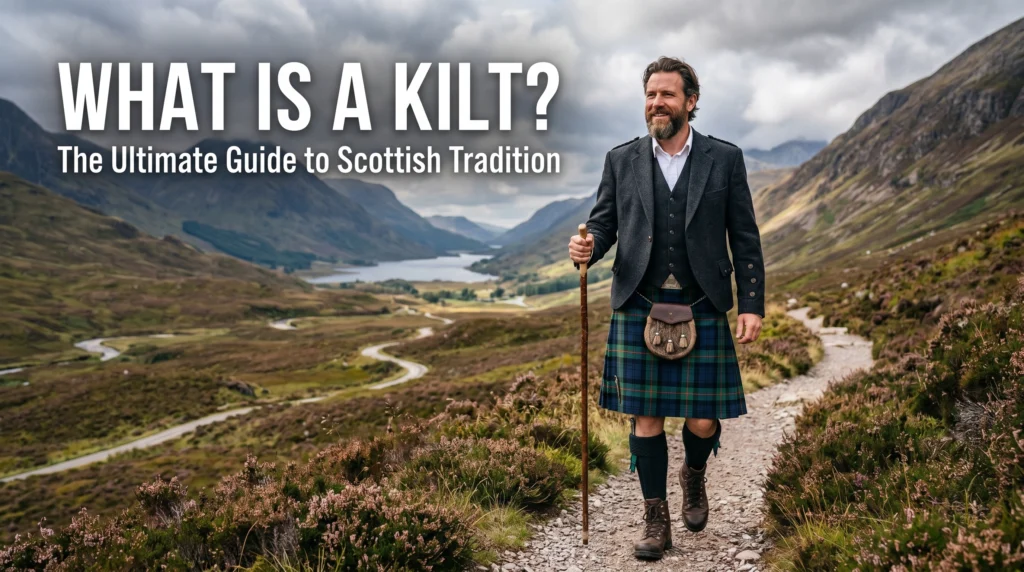
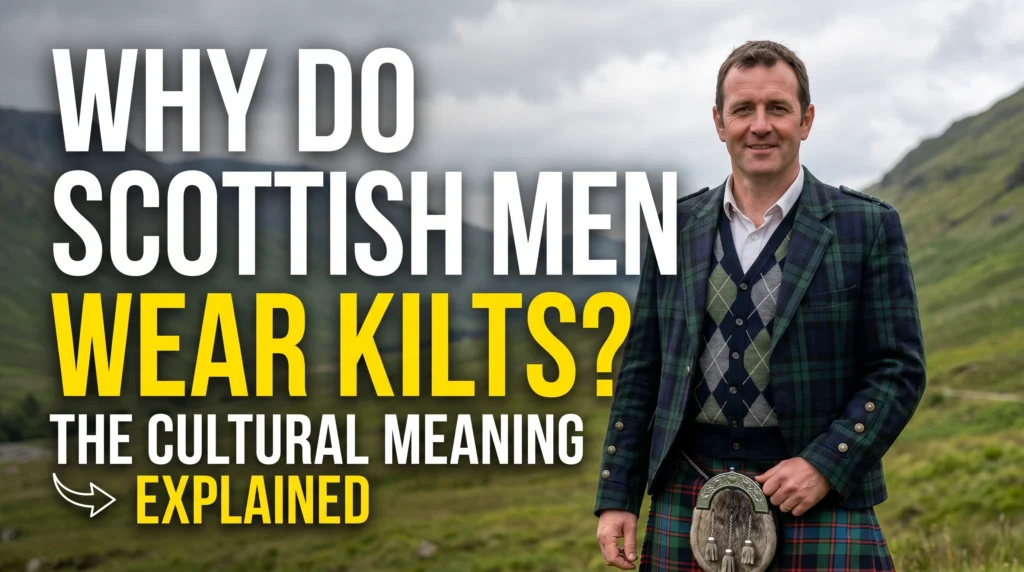
The tartan kilt is still the best-known use. But tartan is everywhere now: tartan trousers, tartan skirts, scarves, ties, waistcoats and home items like cushions and throws. People wear it to weddings, at Highland games, on Burns Night, and just as everyday style. The fabric itself comes in different weights, from soft and light to firm and heavy.
Tartan Kilts
Here are some of our best-loved kilts, each in a different tartan.

Black Watch Custom Made Tartan Kilt-Design 3
Original price was: $149.00.$119.00Current price is: $119.00.
Premium Quality Black Watch Tartan Kilts Design 32
Original price was: $149.00.$119.00Current price is: $119.00.
Premium Quality Grey Watch Tartan Kilt Design 5
Original price was: $549.00.$369.00Current price is: $369.00.Tartan Clothing
Prefer something less formal? Browse more tartan clothing for every day.

Premium Quality Hand Made Scottish Gordon Dress Tartan Plaid Pant for Sale Design 10
Original price was: $150.00.$130.00Current price is: $130.00.
Premium Quality Hand Made Scottish Royal Stewart Tartan Waistcoat for Sale Design 3
Original price was: $89.00.$66.00Current price is: $66.00.
Premium Quality Hand Made Scottish Black Watch Tartan Waistcoat Design 2
Original price was: $89.00.$66.00Current price is: $66.00.Tartan FAQ
Is tartan the same as plaid? Not in Scotland. Tartan is the pattern. A plaid is a long wool wrap worn over the shoulder. In the US, people use “plaid” for any crisscross pattern.
How many tartans are there? More than 10,000 are listed in the Scottish Register of Tartans, and new ones are added all the time.
What is the oldest tartan? The oldest known true tartan was found in Glen Affric and dates to around 1500 to 1600. The Falkirk tartan is older, from about the 3rd century, but it is only a simple two-color check.
Can anyone wear any tartan? Yes. No law stops you. Many people wear their family tartan, a district tartan or one they just like. If you want to wear a regiment’s tartan, it’s polite to have a link to that regiment.
What is tartan made of? Traditionally it is wool, woven in a twill. Today you also find cotton, acrylic and poly-viscose blends, which are lighter and cost less.
Conclusion
Tartan is a simple idea with a long story: stripes that repeat in the same order, woven both ways. It began in the Scottish Highlands, nearly disappeared under the Dress Act, and came back stronger than ever. Today there are over 10,000 of them, and you don’t need to be Scottish to wear one. Pick a tartan that tells your story, or one you just can’t stop looking at.
Ready to find your tartan? Browse our tartan kilts or look up your family colors with the tartan finder.