Kilt Meaning and Definition: Where the Word Comes From

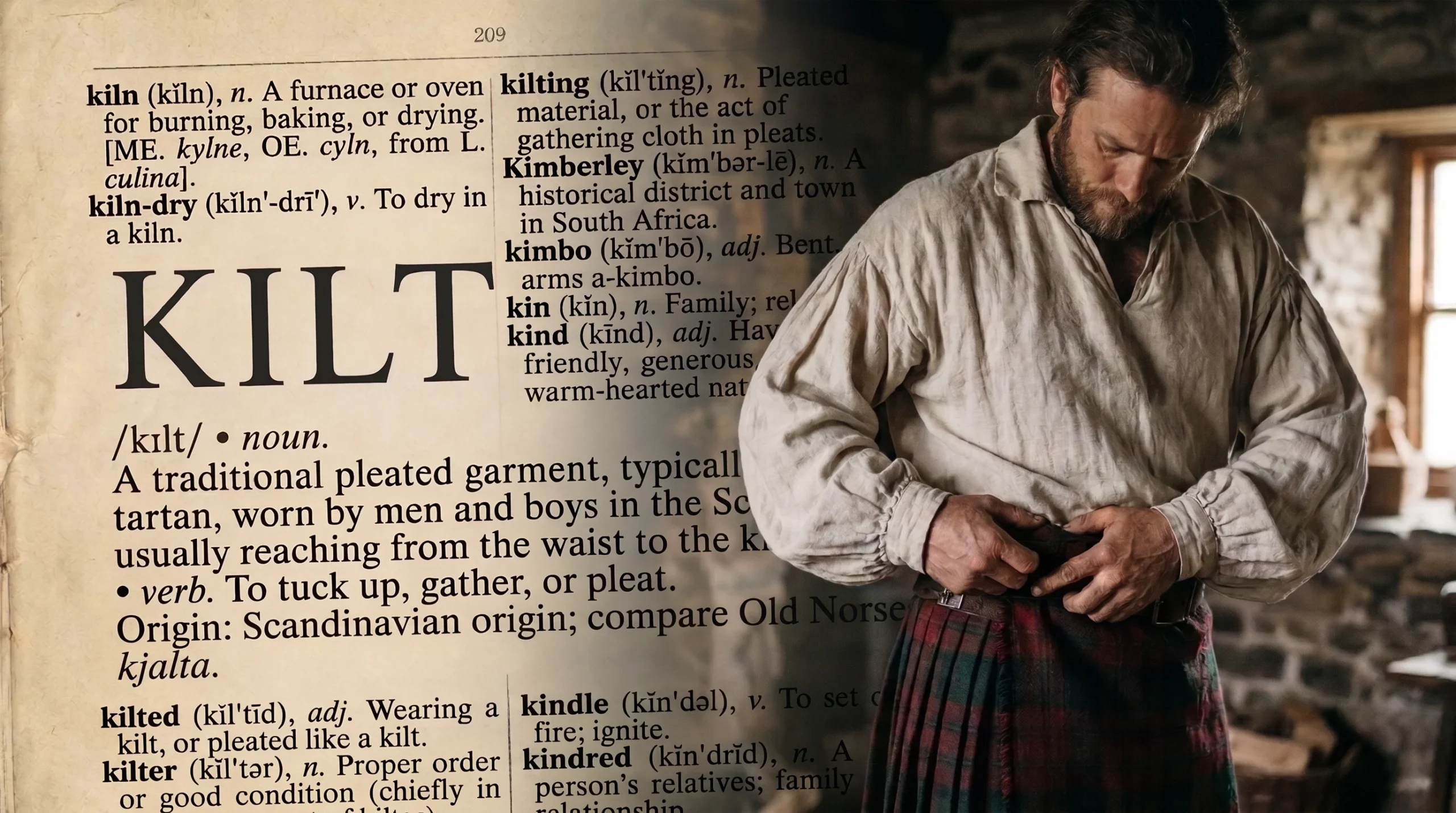
Table of contents
What Does Kilt Mean?
Most dictionaries agree on the main meaning. Merriam-Webster calls a kilt “a knee-length pleated skirt usually of tartan worn by men in Scotland and by Scottish regiments in the British armies.” It also lists a second, wider meaning: any garment that looks like a Scottish kilt.
That wider meaning is how most people use the word today. A casual kilt in cotton with side pockets is still a kilt. So is a leather kilt, a denim kilt or a modern kilt in plain black. What makes it a kilt is the shape: a flat front apron, pleats around the back and sides, and straps and buckles to close it. Those parts of a kilt stay the same whatever the cloth.
Where the Word Kilt Comes From
The word kilt was a verb first. In Middle English, the language spoken in England in the 1300s, people used the verb “kilten” to mean tuck up or gird your clothes, the way you might hitch a long coat or skirt up around your waist to wade through a river or work in a field.
Merriam-Webster dates that verb to the 14th century and says it is of Scandinavian origin. It is linked to the Old Norse word kjalta, which meant lap, or the fold of a gathered skirt. Danish still has kilte, to tuck up, and Swedish has kilta, to swathe. Old Norse was the language of the Vikings, and Norse settlers in northern Scotland and the islands left many words in Scots and northern English.
The noun came much later. Dictionaries put the first use of “kilt” as the name of the garment at around 1730. The short pleated kilt, the one you’d recognize today, appeared in the early 1700s. Before that, Highlanders wore a much longer piece of cloth that they pleated and belted by hand.
The old verb fits the way that earlier garment was put on. A Highlander laid out several yards of wool, gathered it into folds, lay down on it, belted it at the waist and tucked the loose cloth up over his shoulder. In other words, he kilted his plaid.
Traditional Great Kilts
Our great kilts follow that older, belted style.


The Gaelic Words for a Kilt
Kilt is a Scots and English word. Gaelic-speaking Highlanders used two names of their own:
- Fèileadh mòr: the big wrap, also called the great kilt or belted plaid. This was the long version: about four to six yards of wool, worn pleated around the waist with the rest thrown over the shoulder. The Metropolitan Museum of Art dates it to the late 1500s.
- Fèileadh beag: the little wrap, or little kilt. This is the short, knee-length kilt that most people wear today, with the top half of the old plaid left off.
In English and Scots writing, fèileadh beag was spelled many ways: philibeg, philabeg, filibeg and feelybeg. The Dictionary of the Scots Language records “Feelybeg” in a family record from 1745. A year later the word made it into law. The Dress Act of 1746, passed after the Jacobite rising, banned Highland clothing, naming “the Plaid, Philebeg or little Kilt” among the banned items. That ban was lifted in 1782, and the kilt came back as a symbol of Scottish pride.
The word fèileadh itself first meant the whole plaid, the full length of cloth. Only once the belted plaid was cut down did it come to mean the kilt alone.
Kilt as a Verb: Kilted, Kilting and Kilt Up
The verb is still around in a few forms:
- To kilt up means to tuck up your skirts or coat. It’s old-fashioned and mostly Scots now. Lewis Grassic Gibbon used it in his 1933 novel Cloud Howe.
- Kilted means wearing a kilt. You’ll see it in phrases like “a kilted piper”.
- Kilting is the tailor’s word for the pleating on a kilt. A kilt maker might talk about the kilting of a kilt, meaning the run of pleats.
Don’t confuse any of these with the dialect “kilt” that means killed. That’s an unrelated word with the same spelling.
Kilt Words You Should Know
These words come up on almost every kilt product page and order form.
Apron: The flat front of the kilt, with no pleats. It wraps over itself, so you have two layers of cloth at the front.
Pleats: The folds that run around the back and sides. Most kilts use knife pleats, where every fold faces the same way.
Tartan: The pattern of colored stripes that cross each other. Many tartans are linked to a clan, a family name or a place.
Sett: One full repeat of a tartan pattern. A good kilt maker will often “pleat to the sett”, so the pattern still reads clearly across the back.
Plaid: In Scotland, a plaid is a length of tartan cloth, like the fly plaid worn over the shoulder at weddings. In North America, plaid became the everyday word for the pattern itself, which is why woven tartan fabric is often sold there as plaid.
Sporran: The pouch that hangs at the front of the kilt. The name is Gaelic for purse, and you need one because a kilt has no pockets.
Kilt pin: A decorative pin that sits near the bottom corner of the front apron. It adds a bit of weight and decoration. It doesn’t hold the kilt closed, so never push it through both layers.
Kilt hose: The knee-high socks worn with a kilt. The little garter tabs that peek out under the folded top are called flashes.
Tartan Kilts
These are some of our most popular kilts in clan and family tartans.

Black Watch Custom Made Tartan Kilt-Design 3
Original price was: $149.00.$119.00Current price is: $119.00.
Premium Quality Black Watch Tartan Kilts Design 32
Original price was: $149.00.$119.00Current price is: $119.00.
Premium Quality Grey Watch Tartan Kilt Design 5
Original price was: $549.00.$369.00Current price is: $369.00.Is a Kilt Just a Skirt?
By the dictionary, a kilt is a type of skirt, and Merriam-Webster uses that word in its definition. Kilt wearers don’t call it one, and it’s built differently from a skirt.
A kilt wraps around the body and closes with straps and buckles. The front is a flat double apron, and all the pleats sit at the back and sides. A wool kilt made the traditional way uses around eight yards of cloth, far more than any skirt. It sits on the natural waist, higher than trousers, and its hem falls to the middle of the knee. Kilts are also, by long tradition, menswear in Scotland, though all kinds of people wear kilts today.
Length is where most first kilts go wrong. The hem should sit at the middle of your kneecap, not above it. Our kilt size guide shows how to measure for that, and our FAQs answer common ordering questions.
Kilt Meaning FAQ
What language does the word kilt come from? It comes from the Middle English verb kilten, to tuck up, which came from Scandinavian languages. It is related to the Old Norse kjalta, meaning lap or the fold of a gathered skirt.
When was the word kilt first used for the garment? Dictionaries date the noun to around 1730. The verb, meaning to tuck up your clothes, is much older and dates to the 1300s.
What is the Gaelic word for kilt? The Scottish Gaelic word is fèileadh. The great kilt is the fèileadh mòr, or big wrap, and the short modern kilt is the fèileadh beag, or little wrap.
What is a philibeg? Philibeg (also spelled filibeg or philabeg) is an old English spelling of the Gaelic fèileadh beag. It means the little kilt, the short version that is worn today.
Is kilt a real English word? Yes. Kilt is a standard English word found in every major dictionary, used as a noun for the garment and, less often, as a verb meaning to tuck up.
Ready to find your kilt? Browse our tartan kilts or look up your family colors with the tartan finder.